
Suppose you are building a system where incoming data should not leave a specific region. The reason may vary: local regulation, internal security policy, sensitive customer data, latency requirements, or simply your own preference to keep infrastructure closer to users.
This becomes especially important when working with webhooks.
A webhook is not just a technical notification. In practice, it may contain order details, payment events, user identifiers, CRM updates, system alerts, integration payloads, or other data that should be handled carefully. If webhook infrastructure is global by default, it is not always obvious where the request is received, processed, retried, or stored.
Adal was built differently.
When you create an Endpoint in Adal, you choose its region explicitly. That region defines where incoming requests for this Endpoint are received, processed, stored, and delivered from. In other words, the region is not just a label in the dashboard — it is part of the Endpoint’s infrastructure configuration.
For example, if you create an Endpoint in Germany, requests sent to that Endpoint are handled by the German region. If you create another Endpoint in Kazakhstan, its requests are handled separately by the Kazakhstan region. These requests are not mixed between regions.
This allows you to use one Adal account while keeping different webhook flows separated by region.
For example:
European customer data can be received and processed through an Endpoint in Germany or Sweden.
Kazakhstan-specific integrations can use an Endpoint in Kazakhstan.
Internal testing or development traffic can be isolated in a separate region.
Different teams or projects can use different regional Endpoints while still being managed from one dashboard.
This approach gives you more control over your webhook infrastructure without making the operational model more complicated. You still manage Endpoints, Destinations, request history, retries, and delivery status from a single dashboard, but the actual request handling remains tied to the selected region.
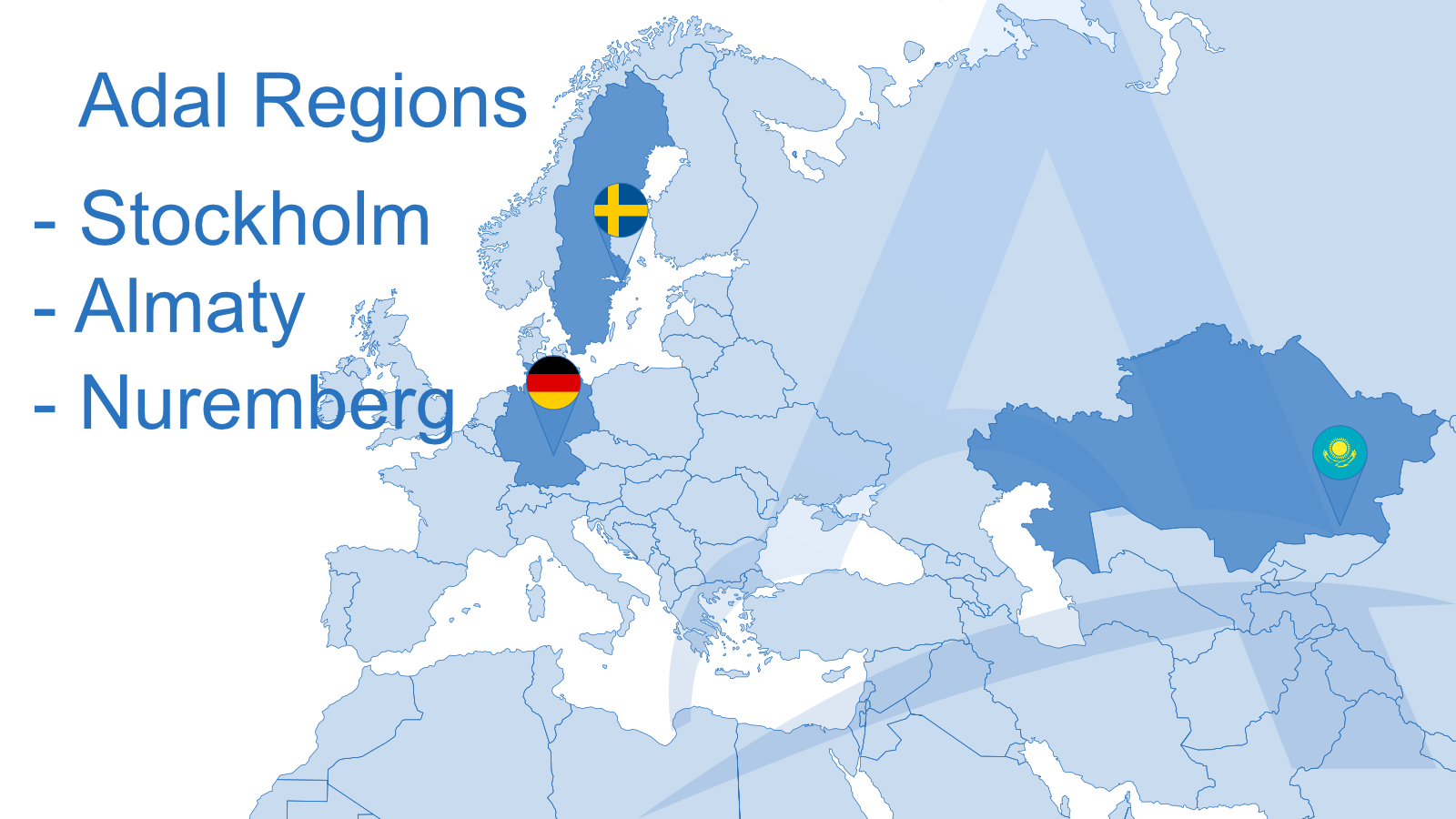
At the time of writing, Adal supports the following Endpoint regions:
Stockholm, Sweden
Almaty, Kazakhstan
Nuremberg, Germany
Each region is deployed with enough network and compute capacity to support reliable request receiving, storage, retry, and delivery. For Adal, regional presence is not only about geography. It is also about predictable routing, transparent infrastructure behavior, and giving users explicit control over where their webhook data is handled.
Adal is also open to expanding into additional regions when there is a practical need for it. If your team needs webhook receiving and delivery in a specific location, we are ready to discuss adding new regional infrastructure.