
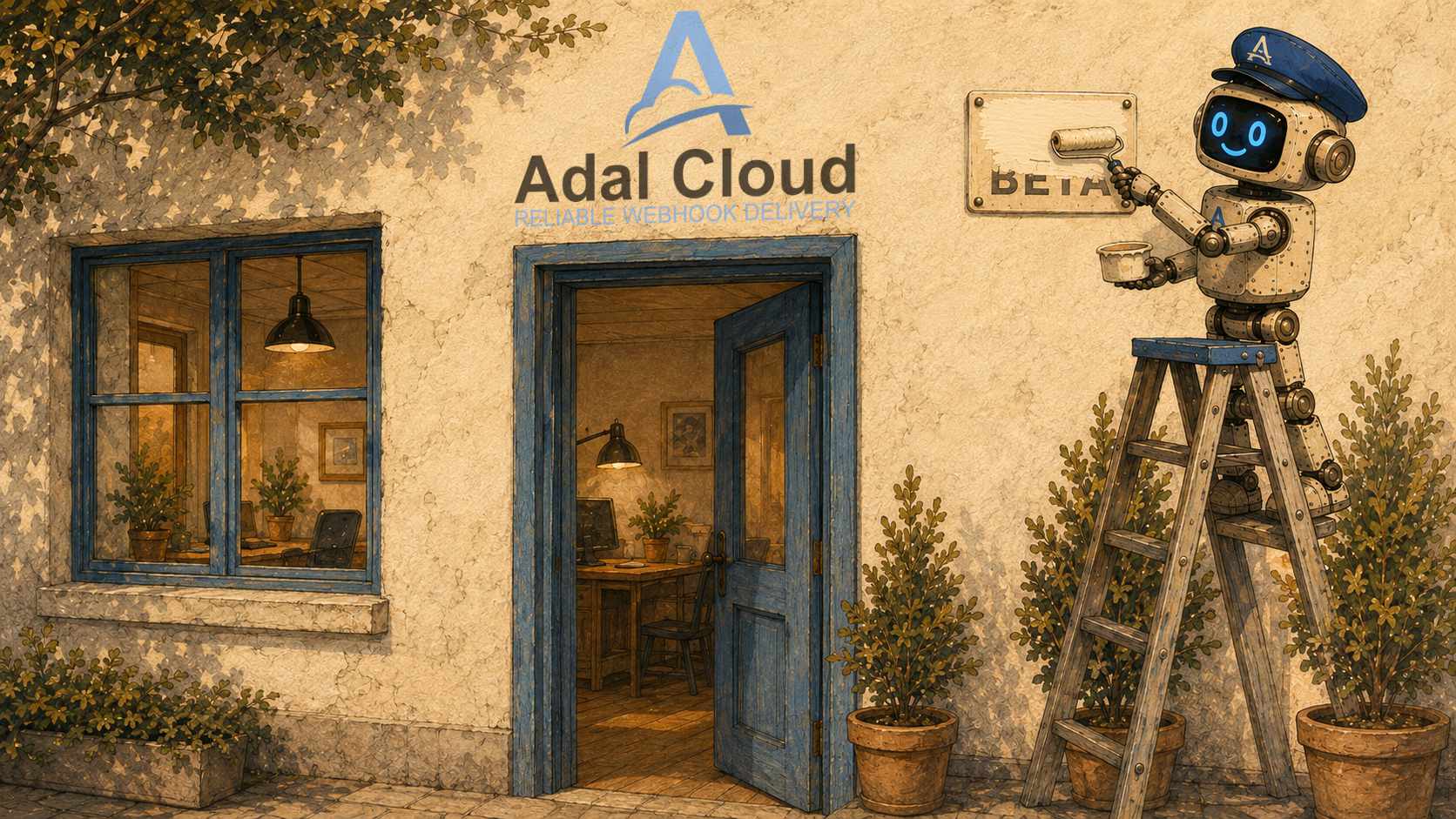
We’re removing the Beta label from Adal Cloud.
Since its public launch in May 2026, the service has grown well beyond its original use case: receiving webhooks from external services and forwarding them to a local machine. Today, Adal Cloud supports incoming and outgoing requests, filtering, routing, and the tools developers need to understand and manage delivery.
Along the way, we’ve gained experience running the service in production, including integrations that handle payment webhooks. Adal Cloud is reliably doing the work it was built for, and we believe it’s ready to move out of beta.
Where we started
Building a webhook integration often means needing real requests from an external service while the application is still running on a developer’s machine. That machine may be behind NAT, without a public IP or an open inbound port. It may also be offline when the next event arrives.
We built Adal Cloud to make that workflow easier. It receives requests at a persistent public HTTPS URL, can store them, and forwards them to a local environment through Adal CLI. Developers can inspect real payloads, test their handlers, and return to saved requests when debugging.
That workflow remains a core part of the product. It also became the starting point for a much broader set of use cases.
What the service does today
An incoming webhook can now be delivered to a public HTTP service, a local application, or a production system on a private network. A single request can be forwarded to multiple destinations, with delivery tracked separately for each one. Filters give developers control over which requests the service accepts.
The dashboard brings request data and delivery attempts into view. Configurable retries help when a recipient is temporarily unavailable. A manual retry repeats an existing delivery, while Replay creates a new request from a saved one. Together, these tools help teams investigate failures and test fixes against the data that triggered them.
We also introduced Adal Outbound, a separate service for outgoing HTTP requests. An application supplies the request and the recipient’s URL; Adal Cloud handles queueing, delivery, retries, and a record of each attempt.
What began as a way to bring webhooks to a local machine has grown into infrastructure for both sides of an integration: receiving events and sending them on. The principle behind it remains the same. Delivery should be predictable, and developers should have the information they need to understand what happened.
Experience in production
An important part of that progress has been seeing Adal Cloud work in integrations that support real product workflows.
In one production setup, payment notifications travel through a Server in Adal Cloud and Adal CLI before reaching the application’s webhook handler. The handler successfully verifies the payment provider’s HMAC signature after the request has passed through the entire route.
For this kind of integration, “roughly the same JSON” isn’t enough. The data covered by the provider’s signature must arrive unchanged. Successful verification confirms that those signed values survived the journey through Adal Cloud intact.
The integration also benefits from request inspection, delivery history, and the ability to retry a failed delivery. The handler can stay on a private network because Adal CLI establishes a secure outbound connection.
Operating and supporting integrations like this has given us a practical basis for assessing the service’s maturity. That experience is behind our decision to remove the Beta label.
What comes next
Leaving beta marks where Adal Cloud stands today: a service that has grown in capability, proved useful in production, and established a foundation for further development.
Our priorities remain reliable delivery, understandable behavior, and a better everyday experience. We’ll keep expanding how teams receive and send webhooks, improving diagnostics, and refining the interface and documentation. Each improvement should make integrations easier to set up and problems easier to investigate.
Thank you to everyone using Adal Cloud, reporting issues, and sharing what you need from the service. That feedback helps us decide what to improve next.
We’re removing the Beta label and continuing to build. There’s plenty more ahead for Adal Cloud.